


What Is DSIP (Delta Sleep-Inducing Peptide)?
Delta Sleep-Inducing Peptide (DSIP) is a naturally occurring short peptide, named for its ability to induce sleep in rabbits and first isolated in 1977 from rat brains during slow-wave sleep. Beyond its sleep-promoting effects, DSIP has several physiological and endocrine functions that are increasingly being explored. Current research indicates that DSIP can modulate corticotropin levels, inhibit somatostatin secretion, reduce stress, help normalize blood pressure, influence sleep patterns, and affect pain perception. Additionally, it holds potential for future applications in cancer therapy, depression management, and protection against free radical damage.
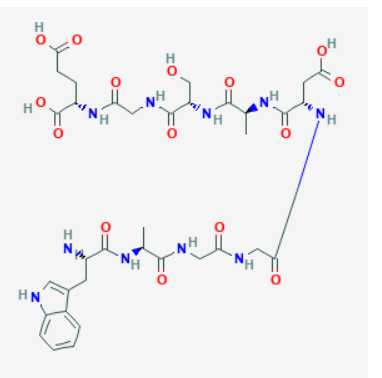
DSIP Structure
DSIP Structure
Sequence: Trp-Ala-Gly-Gly-Asp-Ala-Ser-Gly-Glu
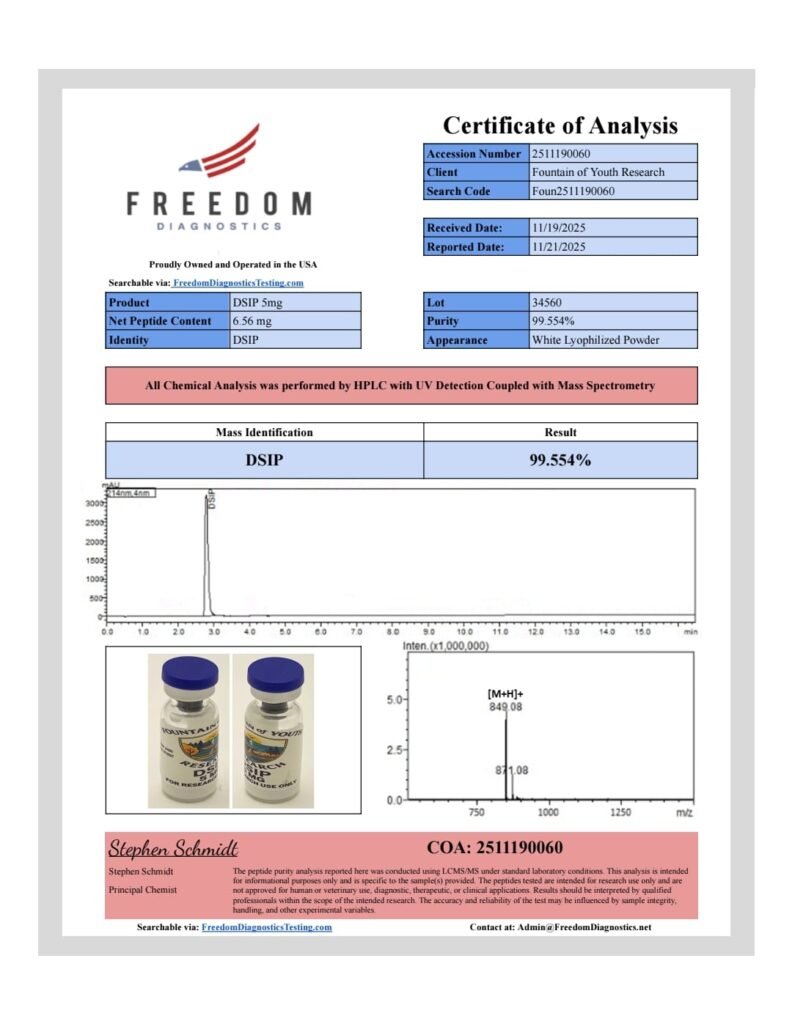
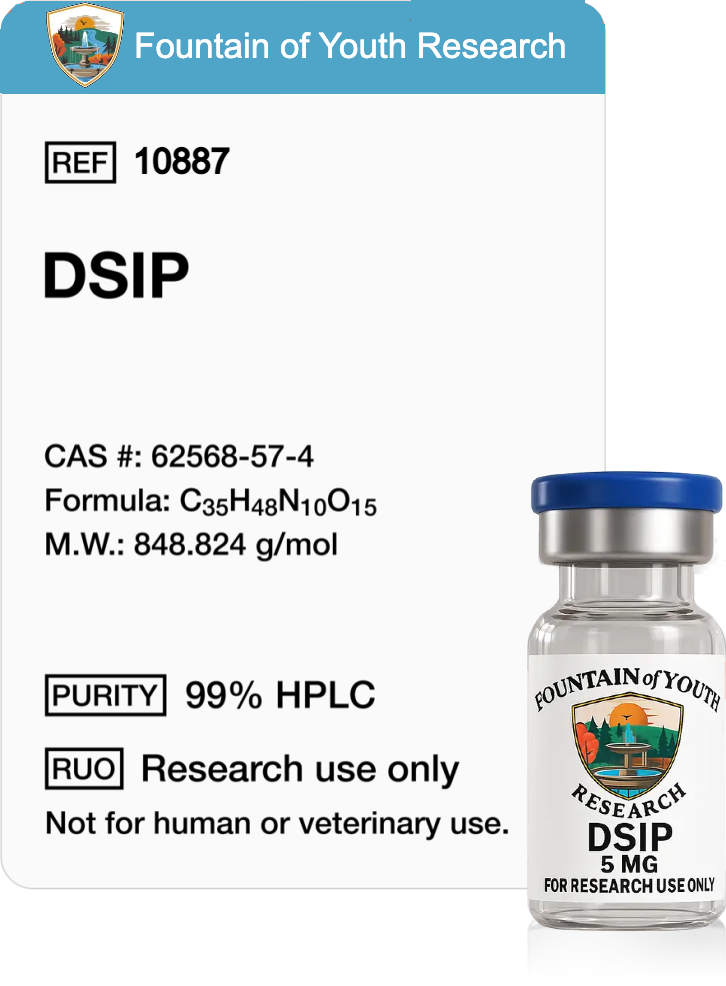
Molecular Formula: C35H48 N10O15
Molecular Weight: 848.824 g/mol
PubChem CID: 68816
CAS Number: 62568-57-4
Synonyms: Emideltide, DSIP nonapeptide, Deltaran
DSIP Research
The Relationship of DSIP to Sleep
Despite its name, the link between Delta Sleep-Inducing Peptide (DSIP) and sleep has proven complex and inconsistent. After its initial discovery in rabbits, DSIP underwent extensive research to determine its effects on sleep, but a clear pattern has been difficult to establish. Some studies report that DSIP promotes slow-wave sleep while suppressing paradoxical (REM) sleep, whereas others find no impact on sleep at all. In one study, DSIP initially caused arousal during the first hour of sleep, followed by sedation in the second hour. Overall, these results suggest that DSIP may help normalize sleep and regulate dysfunction in sleep cycles—a conclusion supported by multiple studies.
The most notable research on DSIP and sleep has been conducted in the context of chronic insomnia. In this setting, DSIP appears to improve sleep quality to levels comparable to normal controls. Other studies show that DSIP enhances sleep structure, reduces sleep latency, and increases overall sleep efficiency, though the magnitude of these effects is modest according to polysomnographic measurements.
Interestingly, subjective reports from human studies consistently indicate that DSIP promotes sleep: participants report increased sleepiness, up to 59% longer sleep duration compared to placebo, and shorter sleep onset times. However, these subjective findings often contrast with EEG data, which show little evidence of sedation. This discrepancy may reflect limitations in current EEG methodologies, which are typically designed to detect pharmacologic rather than natural sedation.
At a minimum, DSIP provides a valuable tool for rethinking how sleep is measured in laboratory settings. By studying its effects, researchers may gain new insights into human sleep physiology—a process that remains only partially understood despite over a century of dedicated study.
DSIP Research and Chronic Pain
Managing chronic pain is challenging, as common treatments like NSAIDs and opioids, though effective in the short term, can cause serious side effects with prolonged use. These medications are generally best suited for acute pain, prompting researchers to explore alternative therapies for chronic pain syndromes.
Preclinical human studies have shown that DSIP can significantly reduce pain perception and improve mood. Additionally, the peptide may be beneficial for patients with physiological dependence on other pain medications, helping to mitigate withdrawal symptoms and the rebound pain often experienced after discontinuing long-term analgesic therapy.
Animal studies in rats suggest that DSIP exerts its analgesic effects through central opioid receptors. While it is not yet clear whether these effects are direct or indirect, DSIP demonstrates a dose-dependent pain-relieving effect. Importantly, despite acting on similar receptors as opioids, DSIP does not appear to produce the dependency associated with opioid medications, making it a promising candidate for safer long-term pain management.
DSIP Research and Metabolism
Studies in rats suggest that DSIP can modulate stress-induced metabolic disturbances, particularly those that cause mitochondria to shift from oxygen-dependent (aerobic) respiration to less efficient oxygen-independent (anaerobic) pathways. This shift is associated with the accumulation of toxic metabolic byproducts. By helping mitochondria maintain oxidative phosphorylation even under hypoxic conditions, DSIP may offer protective effects in situations such as stroke or heart attack, preserving tissue function until normal blood flow is restored.
These properties also position DSIP as a potential antioxidant that operates at a fundamental level, reducing the production of free radicals by maintaining healthy mitochondrial function. While this suggests possible anti-aging benefits, further research is needed to fully understand the peptide’s mechanisms and its overall effects on metabolism and cellular health.
Depression, Chemical Imbalances, and DSIP
The observation that DSIP can influence mitochondrial activity under hypoxic conditions prompted researchers to explore its effects on neurotransmitter regulation. Studies indicate that DSIP helps stabilize monoamine oxidase type A (MAO-A) and serotonin levels, suggesting a potential role in modulating depressive states.
Analysis of cerebrospinal fluid from patients with major depression has revealed lower DSIP levels compared to healthy controls. Given the well-established relationship between sleep and depression, it is plausible that a peptide involved in regulating sleep cycles, like DSIP, could also influence the development or progression of depression.
Although there have been no clinical attempts to treat depression by normalizing DSIP levels, the peptide has been linked to modulation of the hypothalamic-pituitary-adrenal (HPA) axis and may have implications in behaviors associated with suicidality. These findings highlight DSIP as a potential target for further research in mood regulation and psychiatric disorders.
DSIP Research in Withdrawal and Addiction
Clinical trials examining DSIP’s potential to alleviate withdrawal symptoms during opiate and alcohol detoxification have shown promising results. In a study involving 107 patients experiencing alcohol or opiate withdrawal, 97% of those in alcohol withdrawal and 87% of those in opiate withdrawal experienced either complete resolution of symptoms or significant improvement.
Opiate withdrawal proved somewhat more resistant to treatment, requiring a greater number of DSIP injections over an extended period. Given that alcohol withdrawal can be life-threatening, these findings suggest that DSIP may offer a meaningful advancement in the management of withdrawal symptoms, providing a potential therapeutic tool for improving patient outcomes during detoxification.
DSIP Research and Cancer Prevention
While much cancer research focuses on treating the disease after diagnosis, an emerging area of study aims to prevent cancer before it develops. Most preventative approaches involve stimulating the immune system, such as through cancer vaccines, to detect and eliminate malignant cells early.
Mouse studies suggest that DSIP may offer even more potent cancer-preventive effects than vaccines tested to date. In one study, female mice received DSIP for five consecutive days each month, beginning at three months of age and continuing throughout their lifespan. Treated mice exhibited a 2.6-fold reduction in tumor development. This significant decrease in cancer incidence was also accompanied by a 22.6% reduction in chromosomal abnormalities in bone marrow, highlighting DSIP’s potential role in both cancer prevention and genomic stability.
DSIP Being Tested as a Cancer Adjuvant
Chemotherapy can negatively impact central nervous system (CNS) function, leading to issues such as impaired motor control, behavioral changes including depression, and language difficulties. Children are particularly susceptible to these CNS alterations following cancer treatment.
Recent research suggests that DSIP may help prevent or correct these chemotherapy-induced CNS changes. Part of this effect appears to be related to DSIP’s selective influence on cerebral blood flow. Animal studies indicate that DSIP, as well as its analog Deltaran, can significantly increase blood supply to the brain under CNS stress conditions, such as ischemia or chemotherapy. In a rat model of cerebral ischemia, animals treated with Deltaran demonstrated a 100% survival rate compared to 62% in untreated controls. By enhancing cerebral blood flow, DSIP may promote neural recovery and reduce metabolic damage, highlighting its potential as a supportive adjuvant in cancer therapy.
DSIP May Have Widespread Physiologic and Muscle-Building Effects
Delta Sleep-Inducing Peptide (DSIP) was originally discovered in rabbit brains during slow-wave sleep and has been primarily associated with sleep and CNS regulation of sleep-wake cycles. Interestingly, the site and mechanism of DSIP synthesis remain unknown. Levels of DSIP in peripheral tissues are comparable to those in the CNS, suggesting it may be produced outside the CNS and that its primary function might extend beyond sleep regulation.
Some researchers propose that DSIP may act as a hypothalamic hormone with broader regulatory roles, similar to how growth hormone influences multiple physiological systems. For instance, one study found that DSIP inhibits somatostatin, a protein in muscle cells that suppresses growth. By inhibiting somatostatin, DSIP promotes skeletal muscle hypertrophy and hyperplasia, suggesting a direct effect on muscle development. These findings challenge the notion that DSIP is solely a sleep-related peptide and imply a wider role in human physiology.
Animal studies further support the idea of DSIP as a multifunctional peptide, demonstrating effects on blood pressure, heart rate, thermogenesis, and the lymphokine system. Some of these responses occur prior to observable sleep, indicating that DSIP may help prepare the body physiologically for sleep onset.
In preclinical studies, DSIP has shown minimal side effects, low oral bioavailability, and excellent subcutaneous bioavailability in mice. Dosages in mice do not directly translate to humans. DSIP is intended strictly for educational and scientific research purposes and is not approved for human consumption. Purchase and use should be limited to licensed researchers.
| Cas Number | 62568-57-4 |
| PubChem CID | 68816 |
| Molecular Weight | 848.8 g/mol |
| Molecular Formula | C35H48N10015 |
| Synonyms | Emideltide, DELTA SLEEP INDUCING PEPTIDE |
| Storage (Lyophilized) |